
In short
If you have never stayed in a ger (yurt) before, there is not much to worry about. The surprise is usually not how different it is from a regular trip, but how quickly it starts to feel natural.
On GerBnB you are not booking a hotel room. You are booking a home with a real nomadic family. That is why every stay turns out a little different, and why travelers come from all over the world for this.
How does check-in at a Mongolian ger work?
If this is your first night in a ger, this is probably the part with the most questions.
How do you find the camp? Who meets you? What do you do when you arrive? Will it feel awkward?
In practice it is much simpler.
After your booking is confirmed on GerBnB, you get everything you need for the trip. 48–72 hours before arrival, the team sends the current camp coordinates. That matters because some families move camp with the season or with household work.
We recommend planning the drive so you arrive in daylight. You can check sunset in a weather app.
The last kilometers are usually across the steppe, and it is much easier to find your way in daylight. You also have time to settle in, instead of looking for the right ger after dark.
When the car stops at the camp, the host, their partner, or another family member usually meets you.
Do not expect hotel check-in.
Every family greets guests a little differently. Some will walk you through the ger and explain everything you need. Others keep it to the basics. Either way, they will help you settle and answer questions.
If something is still unclear, just ask:
- where the toilet is
- where to get water
- whether there are cooking dishes
- where you can charge a phone
- how to use the stove
- when you can ride a horse or do other activities
- when breakfast usually happens
For the hosts this is everyday life. They may simply not think that someone who has never been on the steppe would need to ask.
GerBnB tip
If you want to bring a small gift for the family, it is always a welcome gesture. Something simple — sweets for the kids, or a souvenir from home — is usually received warmly. It is not a required custom. It is a sign of attention.
The first half hour
After a city, it can feel like nothing is happening around you.
No familiar noise. No stream of cars. No neighboring houses.
Then a few minutes pass, and the details show up.
Someone is moving livestock. Kids are playing by the next ger. Smoke rises from a chimney. The hosts are doing their ordinary work.
That is the moment it becomes clear why GerBnB is different from most travel services.
You are not arriving somewhere that starts when guests show up. You are arriving somewhere life is already going.
Most travelers drop their bags, step out of the ger, and look around in silence for a few minutes.
Not because something unusual is happening. Because after a city, that much open space takes getting used to.
This is not a tour
One of the most common mistakes before the trip is expecting a packaged program.
That is the whole point of GerBnB.
The nomadic family is not playing hosts at a tourist attraction. They are living their ordinary day.
If they are free, you can talk, ask about the household, or see whether you can watch evening work.
Sometimes they will invite you to watch milking or herding. Sometimes you have to take the lead and start the conversation yourself.
Sometimes the family is fully occupied. That is completely normal too.
Do not be shy about taking the initiative in those moments. It tends to land well.
That is why every ger on GerBnB differs not only in the setup, but in the atmosphere.
There are no two identical families. And no two identical trips.
What should you do on the first evening?
Do not try to do everything at once.
After a long drive, just settle in. Walk around the camp. Watch how the steppe changes toward evening. Meet the hosts.
If the GerBnB listing names activities, ask whether they are possible today. Sometimes you can watch household work in the evening; sometimes it is better to wait until morning. You can also mark the activities you want when you book — the host gets a notification.
Do not build a rigid plan. The most interesting parts of these stays rarely happen on a schedule.
Is it cold at night in a Mongolian ger?
This is probably the second most common question after “Is there a toilet?”
Short answer: nights can be cool, even after a +25 °C day.
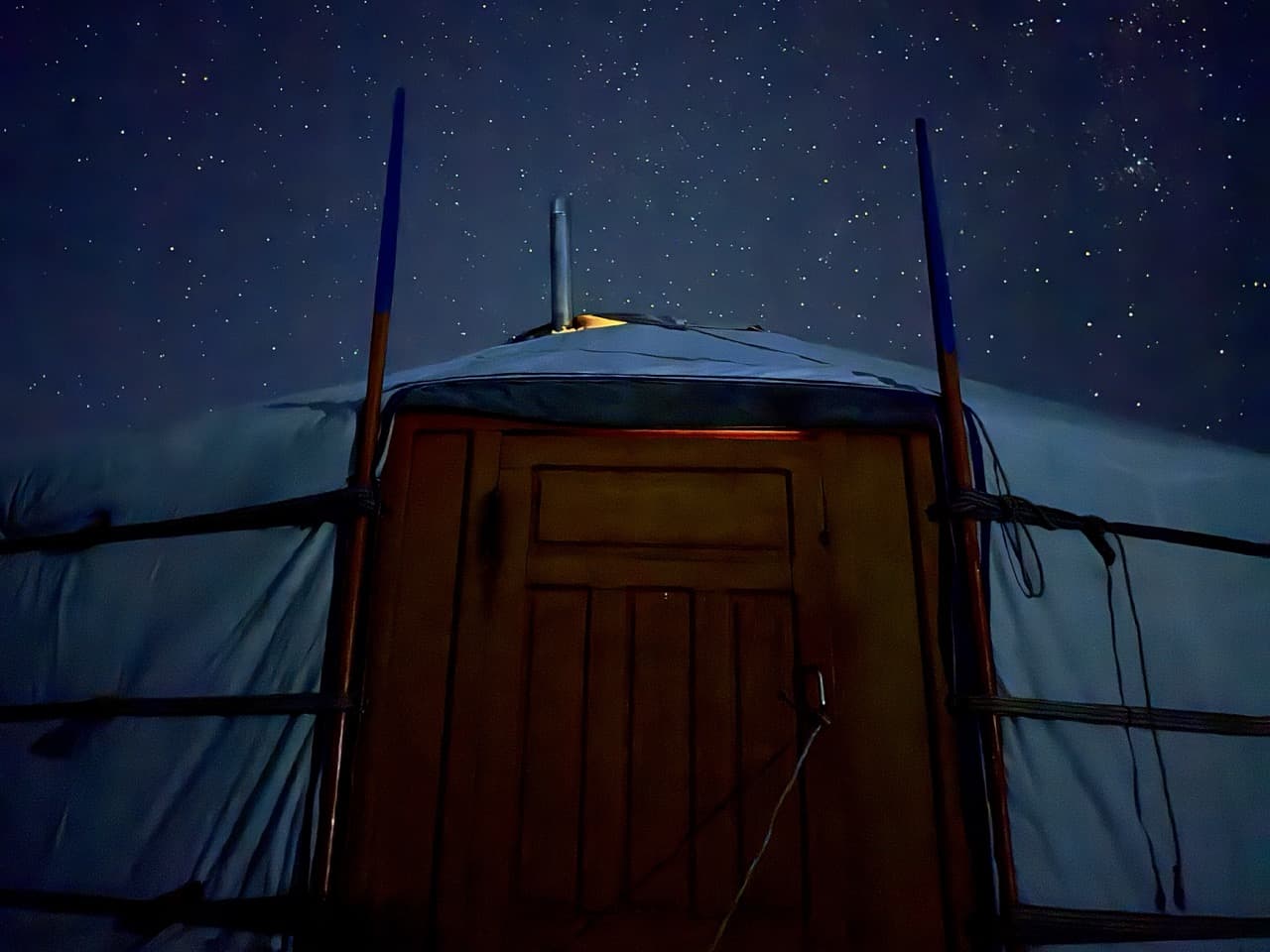
Before sleep, hosts usually help light the stove. It heats the ger quickly, and they will show you how to use it safely if you need that.
On GerBnB we always recommend bringing a windbreaker, a warm layer, long pants, and socks, whatever the season. You will almost certainly want them in the evening or at night.
What surprises many travelers is something else. They brace for unfamiliar sounds. What they remember is the quiet.
No constant city hum. No cars outside. Instead: wind, animals, and ordinary household life around you.
After a while you stop noticing even those sounds and just fall asleep.
Good to know
Even when hosts provide sheets, pillows, and warm blankets, we recommend bringing a sleeping bag. Laundry between guests is harder on the steppe, and some households do not have guest linen.
If you would rather skip the bag, that is fine: hosts usually provide warm blankets. Check the conditions on the specific listing on GerBnB before you go.
How does morning work in a nomadic family?
Morning on the steppe starts much earlier than people from big cities are used to.
While guests are still waking up, hosts may already be with the animals, cooking breakfast, or heading out on household errands.
For them that is an ordinary start to the day.
If you are interested, you can ask whether you would be in the way if you watched the morning work for a bit. Most families are fine with that.
The basic rule is simple. Do not walk into pens or approach animals unless the hosts invite you.
On GerBnB we recommend treating the household the way you would if you were staying with friends.
What is breakfast usually like?
Breakfast is not always included, and you should not expect a hotel breakfast. That information is on the listing.
Every family does it differently.
Some may cook a hot Mongolian breakfast with boortsog. Some put out fresh dairy or home baking.
Sometimes breakfast is very simple, and that is part of ordinary nomadic household life too.
If you have allergies or dietary limits, tell GerBnB ahead of time. If there are foods you cannot do without, bring them with you.
Before you leave
Standard departure on GerBnB is by 11:00, but you can always agree a different time with the hosts in advance.
Before you get on the road, check that you did not leave anything in the ger.
Take your trash with you if you can. That is a real help for the family, especially when the camp is far from a town.
Even if you barely spoke because of the language barrier, do not forget to thank the hosts.1
To them you were not a hotel client. You were a guest in the house.
Common guest mistakes
If this is your first ger stay, try to avoid a few common mistakes.
- Arriving after sunset. Finding camp in the dark is much harder, even with coordinates.
- Skipping warm clothes in summer. After sundown the steppe cools fast.
- Expecting hotel service. On GerBnB you are booking a stay with a real family, not a hotel room.
- Skipping the listing. Conditions differ. Before you book, read the card for the ger you chose on GerBnB. It says whether there is a shower, toilet, electricity, internet, and a kitchen, which activities are available, and what is included.
Why is every ger different?
This is one of GerBnB’s main principles.
We are not trying to make every ger the same. The opposite.
Each family hosts in its own way. Each has its own daily rhythm, its own traditions, and its own experience with guests.
That is why, when you choose a stay, we recommend looking not only at the photos, but at the description, the amenities, and the stay format.
On GerBnB you can choose:
- Family Ger — you stay with the nomadic family
- Shared Ger — a bed in a guest ger. Other guests may be in the ger too. This is the budget option for solo travelers
- Private Ger — a fully private ger for you and the people you are traveling with
That makes it easier to pick a format that actually matches what you want.
How we put this together
The GerBnB team regularly visits the households on the platform, meets the families in person, and checks the living conditions.
This article is based not only on the team’s experience, but on answers from hosts who receive guests at home every day.
That is why some details still depend on the specific family. Current information for each ger is always on the listing before you book.
Footnotes
-
Bayarlalaa — “thank you” in Mongolian. ↩